Horizon Europe
The European Union's framework programme for research and innovation (2021-2027)

Horizon Europe is the European Union's framework programme for research and innovation for the period 2021-2027. It funds activities defined in successive work programmes — scientific research, development, demonstration, networking or innovation depending on the instrument — to produce knowledge, address societal challenges and strengthen European competitiveness.
The programme is organised into three pillars and a cross-cutting component for widening participation (WIDERA): Pillar I (scientific excellence: ERC, Marie Skłodowska-Curie actions, research infrastructures), Pillar II (six thematic clusters and European missions) and Pillar III (innovation: EIC, European innovation ecosystems, EIT). Each component has its own work programme and its own rules — Horizon Europe should never be treated as a single window with uniform conditions.
Who runs and who funds it
Publishes work programmes and manages most calls for projects via the Funding & Tenders portal.
Pillar III — instruments dedicated to breakthrough innovation (Accelerator, Pathfinder, Transition), with its own work programme separate from the rest of the programme.
Pillar I — funding for exploratory research led by researchers, with its own work programme.
Operate certain national components linked to European partnerships or co-financing, depending on the scheme.
The main financing instruments
Funds research activities, often within a transnational consortium, without expecting an immediate commercial outcome.
Funds activities closer to market — demonstration, pilots, scale-up — with eligible cost rules distinct from RIA.
Funds networking, dissemination or coordination of projects, not R&D itself.
Instrument reserved for innovative deep-tech start-ups and SMEs, combining, depending on the case, a grant and equity investment.
How a call for projects unfolds
- 1Identify the right topic
Describe the project in terms of problem, solution, maturity level and expected results, then search for the matching topic on the Funding & Tenders portal — never based solely on the title or a sector keyword.
- 2Read the full text and annexes
Check the opening date, deadline, type of action, indicative contribution, expected number of projects and eligibility conditions of the precise topic, not of the programme in general.
- 3Build the consortium
Most collaborative calls require a transnational consortium — the number of partners, countries and roles required vary depending on the type of action and the topic.
- 4Submit the application
The application must explicitly address the topic's evaluation criteria: methodology, partners' expertise, work plan and expected impact.
- 5Evaluation and decision
Evaluated by experts according to the topic's published criteria; a high score remains a pre-selection, never a guarantee of funding before official notification.
Combining with other grants
The rules on cumulation and funding (rates, eligible costs, indirect costs, payment conditions) are defined by the type of action and the topic, not by the programme as a whole — an indicative contribution published for a topic is neither a guaranteed individual ceiling nor an automatic reimbursement rate. Always check the general annexes and the text applicable to the specific call.
Common mistakes to avoid
- Confusing the framework programme with a specific call: eligibility, funding and consortium rules must be checked topic by topic, never at the level of Horizon Europe as a whole.
- Treating a published indicative contribution as a guaranteed funding rate or a secured individual ceiling.
- Ignoring the type of action (RIA, IA, CSA...): it determines eligible costs and consortium expectations, and should never be inferred from the topic title alone.
- Assuming a company can apply alone without checking whether the topic requires a transnational consortium.
- Relying on a third-party summary rather than the official work programme text and its annexes.
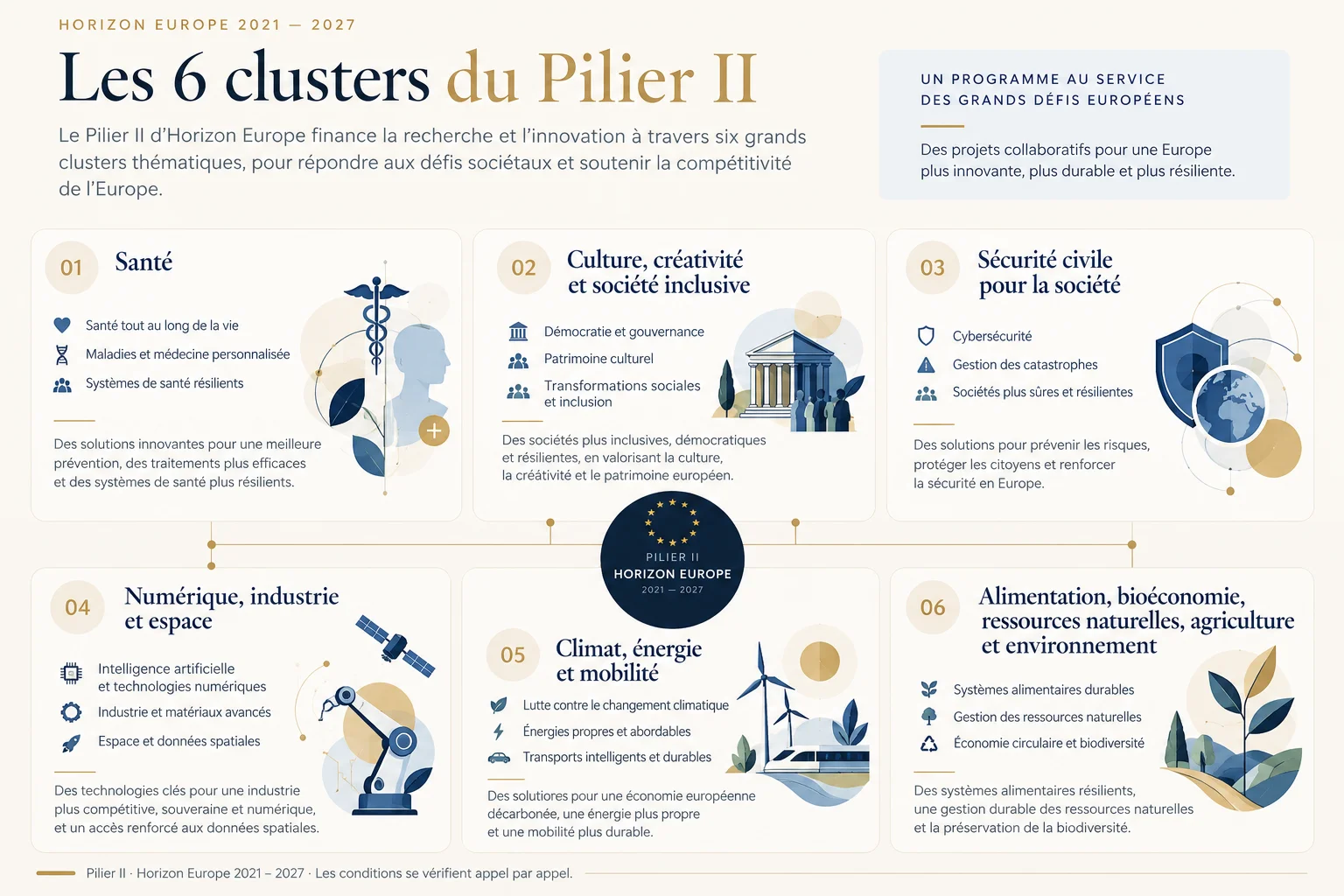 Enlarge infographic ↗
Pillar II clusters in detail
Cluster 1 — Health
Cluster 1 aims to improve and protect people's health and well-being at every age, funding both fundamental research into disease mechanisms and the development of care tools, technologies and policies. It is organised around six official destinations covering the whole pathway: prevention in the general population, environmental determinants of health — including the effects of climate change —, understanding and treating infectious, non-communicable or rare diseases, the organisation of and access to healthcare systems, digital and biomedical tools (AI in health, NAMs, personalised medicine), and finally the competitiveness of the European health industry, particularly on the regulatory front. A company or consortium applying must first precisely identify which of these six destinations matches its project: developing a medical device, for example, does not fall under the same destination as an epidemiological study or a clinical decision-support tool. Industrial players are present, but are almost always associated with clinical research bodies or healthcare institutions, rarely alone. The topics funded range from upstream research (RIA) to actions closer to deployment (IA), via coordination actions between national health systems (CSA). Cluster 1 also funds, through co-financed partnerships, long-term research infrastructures on rare diseases or pandemic preparedness. As with the other clusters, each topic has its own timetable, its own indicative budget and its own consortium conditions: the cluster's name guarantees neither eligibility nor the amount accessible — only the precise topic sheet is authoritative.
- Staying healthy — prevention, behaviours and social determinants (3 entries in the database)
- An environment conducive to health — environmental exposures, including the effects of climate change (5 entries in the database)
- Diseases — prevention, diagnosis, treatment and reducing the burden of disease (15 entries in the database)
- Access to care — organisation, quality and efficiency of health systems (4 entries in the database)
- Tools and technologies — AI in health, NAMs, personalised medicine, biomedical innovations (8 entries in the database)
- Health industry — industrial competitiveness and regulatory science (3 entries in the database)
Cluster 2 — Culture, Creativity and Inclusive Society
Cluster 2 funds research and innovation on European democratic, social and economic transformations, as well as on cultural heritage and the creative industries. It is structured around three major destinations that, between them, cover almost all of the topics funded: democracy and governance (democratic resilience, disinformation, citizen participation, fundamental rights), cultural heritage (conservation, promotion, sustainable cultural tourism, creative ecosystems), and social and economic transformations (employment, social protection, education, inequalities, population ageing). Unlike more technical clusters such as Cluster 4 or Cluster 5, the projects funded here often fall within the humanities and social sciences, but not exclusively: several topics combine social science research with the development of digital tools, for example to combat disinformation or to measure the societal impact of cultural heritage. A company in the creative sector, cultural tourism or media can find relevant topics in this cluster, provided it can partner with research organisations and demonstrate a genuine scientific contribution, not merely a standard commercial activity. The three destinations are of comparable size in terms of number of topics, reflecting an intended balance between the cluster's democratic, heritage-related and socio-economic issues. As elsewhere in Horizon Europe, each topic specifies its own type of action (research, coordination, or more rarely demonstration), its own timetable and its own consortium conditions — the cluster defines a thematic scope, not uniform funding rules. Indicative budgets here are generally more modest than in the technology-oriented clusters, reflecting the often exploratory or collaborative nature of the projects funded, geared more towards producing knowledge actionable by public decision-makers than towards developing a commercial product.
- Democracy and governance — democratic resilience, disinformation, citizen participation (19 entries in the database)
- Cultural heritage — conservation, promotion, sustainable cultural tourism (16 entries in the database)
- Social and economic transformations — employment, education, inequalities, ageing (19 entries in the database)
Cluster 3 — Civil Security for Society
Cluster 3 funds research and innovation aimed at strengthening European society's resilience to disasters, crime, terrorism and threats to critical infrastructure and cyberspace. It is structured around six official destinations: border management (surveillance, threat identification, facilitating legitimate travel), disaster resilience (prevention, preparedness and response to natural or industrial disasters), fighting crime and terrorism, protection of critical infrastructure (energy, transport, water), security research and innovation in the broad sense, and cybersecurity — the latter being steered in connection with the European Cybersecurity Competence Centre (ECCC). The projects funded typically bring together public authorities (police, civil protection, customs), security and civil defence industry players, and technical research organisations. One point of attention specific to this cluster: several topics impose enhanced security and confidentiality conditions, and some explicitly exclude entities controlled by non-associated third countries — checking the general annexes is therefore particularly necessary before applying. The components dedicated to cybersecurity are also linked to calls under the Digital Europe Programme and the ECCC, with shared governance rules that differ slightly from the rest of the work programme. Technology companies play a more central role here than in other Pillar II clusters, particularly in the critical infrastructure and cybersecurity components, where operational demonstration often matters as much as upstream research. As with the other clusters, the volume of topics varies considerably from one destination to another, with the fight against crime and general security research accounting for a significant share of the calls.
- Border management — surveillance, identification and facilitating legitimate travel (5 entries in the database)
- Disaster resilience — prevention, preparedness and response (6 entries in the database)
- Fighting crime and terrorism (7 entries in the database)
- Critical infrastructure — protecting energy, transport, water (4 entries in the database)
- Security research and innovation (7 entries in the database)
- Cybersecurity — in connection with the European Cybersecurity Competence Centre (3 entries in the database)
Cluster 4 — Digital, Industry and Space
Cluster 4 'Digital, Industry and Space' funds research and innovation across five major families of work, with no direct link to general support for digitalisation or business modernisation: each call targets a precise technical scope defined by the Commission in its work programme. Advanced materials and production processes form the largest family — substitution of substances of concern, critical materials, recycling of secondary raw materials, new production lines. Digital technologies and emerging AI cover artificial intelligence applied to industrial sectors, quantum computing, photonics and next-generation robotics. The data and digital infrastructure family funds data access and compliance, open platforms and edge/cloud computing. Space covers space technologies critical to European autonomy — components, spaceports, demonstration missions, Earth observation. Virtual worlds and Web 4.0, finally, fund immersive technologies and their interoperability. The expected applicants vary significantly from one family to another: research laboratories and materials manufacturers for MAT-PROD, technology consortia for AI and digital, equipment manufacturers and operators for space. Several calls fund ecosystem coordination actions rather than a standalone R&D project — a company seeking a direct grant for its own product is not always the right profile; each topic's guide specifies the actual funding mechanism (direct grant, cascade funding to third parties, two-stage action). As with the other clusters, the timetable, indicative budget and consortium conditions must be checked topic by topic: several calls in this batch are already closed and kept for historical reference, others are announced for a later opening — their exact status is stated on each sheet, never assumed open by default.
- Advanced materials and production — substitution, critical materials, recycling, new production lines (31 entries in the database)
- Digital technologies and emerging AI — applied AI, quantum, photonics, robotics (21 entries in the database)
- Space — components, spaceports, demonstration missions, Earth observation (15 entries in the database)
- Data and digital infrastructure — data access and compliance, edge/cloud (6 entries in the database)
- Virtual worlds and Web 4.0 — immersive technologies and interoperability (5 entries in the database)
Cluster 5 — Climate, Energy and Mobility
Cluster 5 is one of Horizon Europe's largest clusters in terms of funding volume: it covers the entire chain from understanding the climate system through to deploying low-carbon energy and transport solutions. It is organised around six official destinations, structured along two main axes. The first, climate-related, brings together climate science (modelling, attribution of extreme events, carbon-neutrality pathways) and cross-cutting solutions that span several sectors at once (carbon capture, low-carbon materials, territorial demonstrators). The second axis, energy and transport, covers energy supply (renewables, batteries, hydrogen), energy use on the demand side (smart buildings, heat recovery), clean solutions for each transport mode taken individually (aviation, maritime, road, rail), and finally smart mobility, which addresses transport systems as a whole — automated driving, urban logistics, network resilience. Transport and mobility together account for nearly half of the cluster's topics, reflecting the scale of the sector's decarbonisation challenges. Industrial companies, infrastructure operators, technology SMEs and public authorities find varied entry points here, from upstream research on battery materials to automated mobility demonstrators in real-world conditions. As with the other clusters, the type of action (research, demonstration or coordination), the timetable and the consortium conditions must be checked topic by topic — the cluster's overall financial volume says nothing about the conditions of a specific call. Several calls involve a two-stage procedure, with a preliminary short proposal required before the full application; this additional formality must be anticipated from the outset when building the consortium.
- Climate science — modelling, attribution, carbon-neutrality pathways (7 entries in the database)
- Cross-cutting solutions for climate — carbon capture, low-carbon materials (4 entries in the database)
- Energy supply — renewables, batteries, hydrogen (8 entries in the database)
- Energy use — smart buildings, heat recovery (4 entries in the database)
- Transport — clean solutions by mode (aviation, maritime, road, rail) (12 entries in the database)
- Smart mobility — automated driving, urban logistics, network resilience (5 entries in the database)
Cluster 6 — Food, Bioeconomy, Natural Resources, Agriculture and Environment
Cluster 6 is Horizon Europe's largest cluster in terms of number of topics: it covers food systems, agriculture, biodiversity, the circular bioeconomy, water and pollution management, and environmental governance. Seven official destinations structure it. Food and agri-food systems — from primary production to processing — account for the largest number of topics, followed by the circular economy and bioeconomy (recycling, bio-based materials, biomass valorisation). Biodiversity covers understanding and restoring ecosystems, both terrestrial and marine. Zero pollution deals with preventing and reducing air, water and soil pollution. Climate, within this cluster, focuses specifically on the interactions between land, oceans, water and climate action — to be distinguished from the climate science addressed more broadly under Cluster 5. Governance and data cover public policy, environmental observation and digital tools in support of the Green Deal. Finally, territorial communities target the resilience of rural, coastal and urban areas. An agri-food company, a circular-economy SME or a water-management player will find numerous entry points here, but the sheer diversity of the cluster requires carefully choosing the relevant destination rather than applying on the basis of sector of activity alone. Several topics in this cluster are also linked to co-financed European partnerships (bioeconomy, organic farming) whose governance and consortium rules differ slightly from standard calls — this must always be checked in the topic's text. The cluster has also seen the most recent additions to the work programme, with several destinations (zero pollution, territorial communities) still only partially documented at the time this guide was written.
- Food and agri-food systems — Farm2Fork, from production to processing (28 entries in the database)
- Circular economy and bioeconomy — recycling, bio-based materials, biomass valorisation (25 entries in the database)
- Biodiversity — understanding and restoring ecosystems (19 entries in the database)
- Governance and data — public policy, environmental observation (19 entries in the database)
- Zero pollution — preventing and reducing air/water/soil pollution (8 entries in the database)
- Climate — interactions between land, oceans, water and climate action (6 entries in the database)
- Territorial communities — resilience of rural, coastal and urban areas (3 entries in the database)
Frequently asked questions
Is Horizon Europe reserved for universities?
No. Eligible participants and roles depend on the work programme and the call. Companies can take part in certain actions, but are not eligible for every opportunity — the beneficiary category, country and conditions of the specific topic must be checked.
Can an SME apply alone?
It depends on the action. Some instruments such as the EIC Accelerator allow an individual application, while many collaborative topics require a transnational consortium. Never infer the rule from the programme's name alone: read the topic and its annexes.
What amount can Horizon Europe fund?
There is no single amount applicable to the whole programme. Budgets, indicative contributions, rates and eligible costs vary by action and by topic — each element must be checked separately rather than inferred from an average or an example.
Where can official dates and documents be checked?
The European Commission's page references the work programmes by part (clusters, EIC, ERC...), and the Funding & Tenders portal lists the actual calls with their dates, status and documents. Always record the date consulted, as statuses (Forthcoming, Open for submission, Closed) change over time.
Source: European Commission — Horizon Europe work programmes, accessed on 12 October 2026. General presentation guide — does not replace the official specifications of each call for projects.
Targeting Horizon Europe?
Check which schemes fit your business
This guide presents the general framework of the programme. Your personalised report applies your actual criteria — sector, size, location, project — before any eligibility conclusion.
Discover the opportunities identified by the scan, then access your personalised report.